1870 —
History
From a Neapolitan foundry founded in 1870 to the company that carries its heritage today.
Timeline
Timeline
1870
The foundry is established
Gennaro Chiurazzi (1840–1906) opens a small foundry in Naples, located first near the National Archaeological Museum.
The Albergo dei Poveri
Rapid success brings a larger workshop in the Albergo dei Poveri in Naples, where a team of formatori (mould makers) takes casts of famous statues.
Moulds from Italy’s great museums
Over the years the foundry takes moulds of works in the Museo Archeologico Nazionale in Naples; the Capitoline Museums, the Vatican and the Borghese Gallery in Rome; and the Palazzo Pitti and the Uffizi in Florence. The collection grows to more than 1,500 plaster piece moulds.
The lost-wax technique
Rather than the more widespread sand casting, the foundry works in the traditional lost-wax technique, which gives its replicas very high fidelity to the originals. It becomes one of the leading makers of replicas of ancient works, especially from Pompeii and Herculaneum.
1893
Chicago
The foundry makes its first major international appearance, at the World’s Columbian Exposition in Chicago, under the direction of Gennaro Chiurazzi.
1895
A family business
Gennaro Chiurazzi brings his sons, Federico and Salvatore, into the business.
1905
Supplier to courts and museums
The catalogue “J. Chiurazzi & Fils – Fournisseurs de Cours et Musées” presents the foundry’s reproductions to French-speaking clients and records its participation in universal expositions including London, Paris, Chicago, St. Louis, Edinburgh and Rome.
1906
A new generation
Gennaro Chiurazzi dies on 25 April 1906, and Federico and Salvatore take over the foundry.
1929
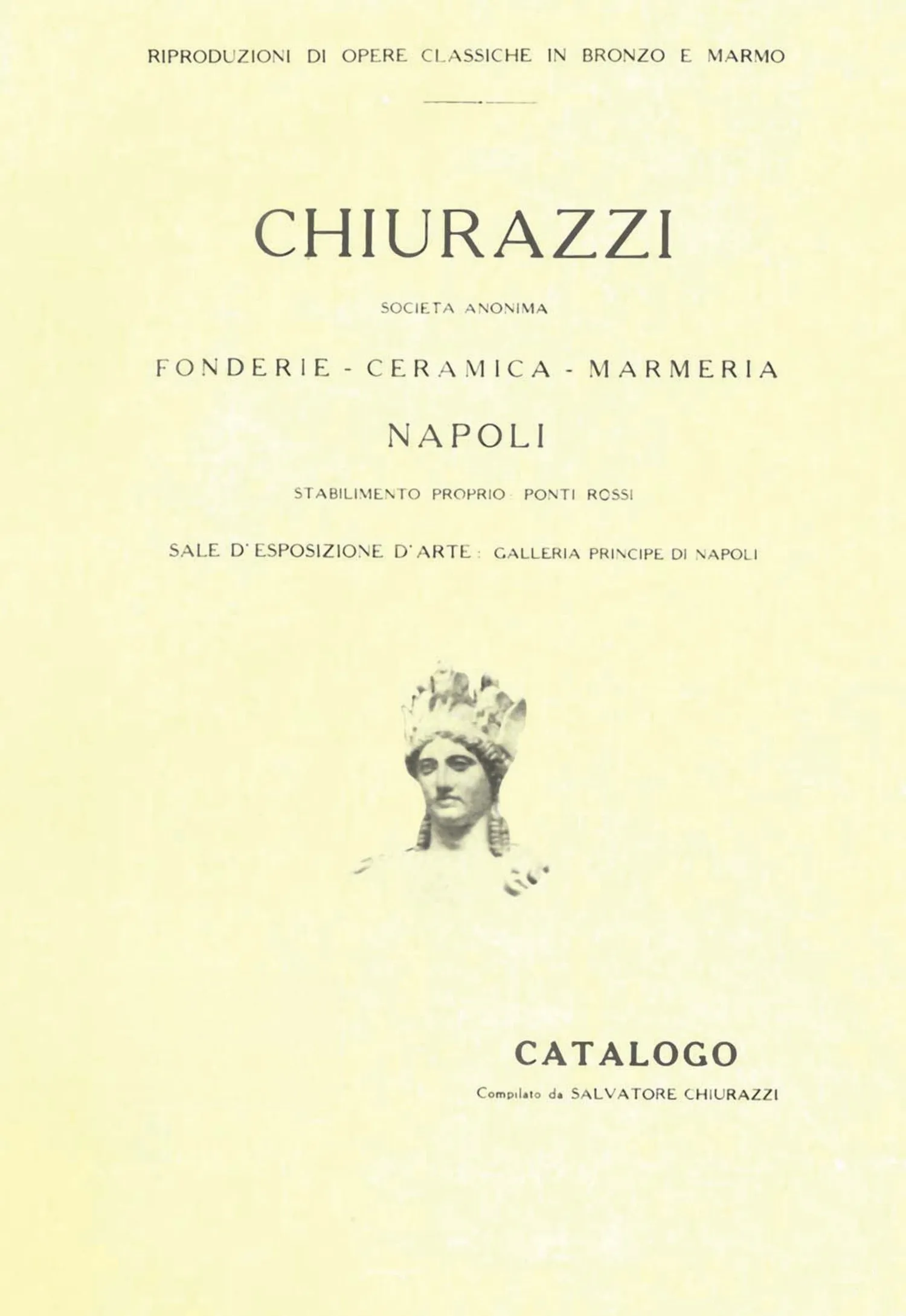
The 1929 catalogue
The catalogue compiled by Salvatore Chiurazzi offers reproductions of statues, armour, mosaics and vessels from the Naples Museum and other European museums, in three finishes: Herculaneum (dark), Pompeii (greenish) and Rinascimento (gleaming bronze).
Early 1970s
From Pompeii to Malibu
Chiurazzi provides a series of replicas of sculptures from the Villa dei Papiri for J. Paul Getty’s villa in Malibu.
November 2000
The Fonderia Storica Chiurazzi
Professor Clemente Setaro acquires the foundry and its entire collection of plaster casts at a court auction. As the Fonderia Storica Chiurazzi, it is run by A.I.D.A. (Accademia Italiana delle Arti) from new premises in Calvizzano, near Naples.
2010
Chiurazzi Internazionale
Chiurazzi Internazionale S.r.l. is founded and acquires the business from A.I.D.A.
June 2022
Moulds acquired by the Pompeii Archaeological Park
In the course of the company’s insolvency proceedings, the Parco Archeologico di Pompei (Pompeii Archaeological Park) acquires about 1,650 items from the foundry’s heritage: casting moulds (“negativi”), sketches and plaster copies.
The company continues
Following the conclusion of insolvency proceedings, the company continues as Chiurazzi Internazionale S.r.l.
Today
Stewarding the Chiurazzi name
The company is building a catalogue raisonné of Chiurazzi works, promoting the Chiurazzi name, and helping owners of Chiurazzi sculptures document and sell their works.
Chiurazzi works around the world
The foundry’s clients included museums, schools, private collectors and hotels. Chiurazzi works are held in collections around the world.
Sources
- Luisa Fucito (ed.), Fonderia Artistica Chiurazzi: La forma dell’arte, Altrastampa Edizioni, Naples, 2001.
- Luisa Fucito, “Methods and Materials Used for Patination at the Fonderia Chiurazzi,” J. Paul Getty Museum.
- Getty, “Chiurazzi Bronzes, from Pompeii to Malibu.”
- ANSA, 3 June 2022.
- Naples Chamber of Commerce, Companies Register.